
The Veteran Business Ecosystem: Beyond Franchise Coaching & Federal Set-Asides
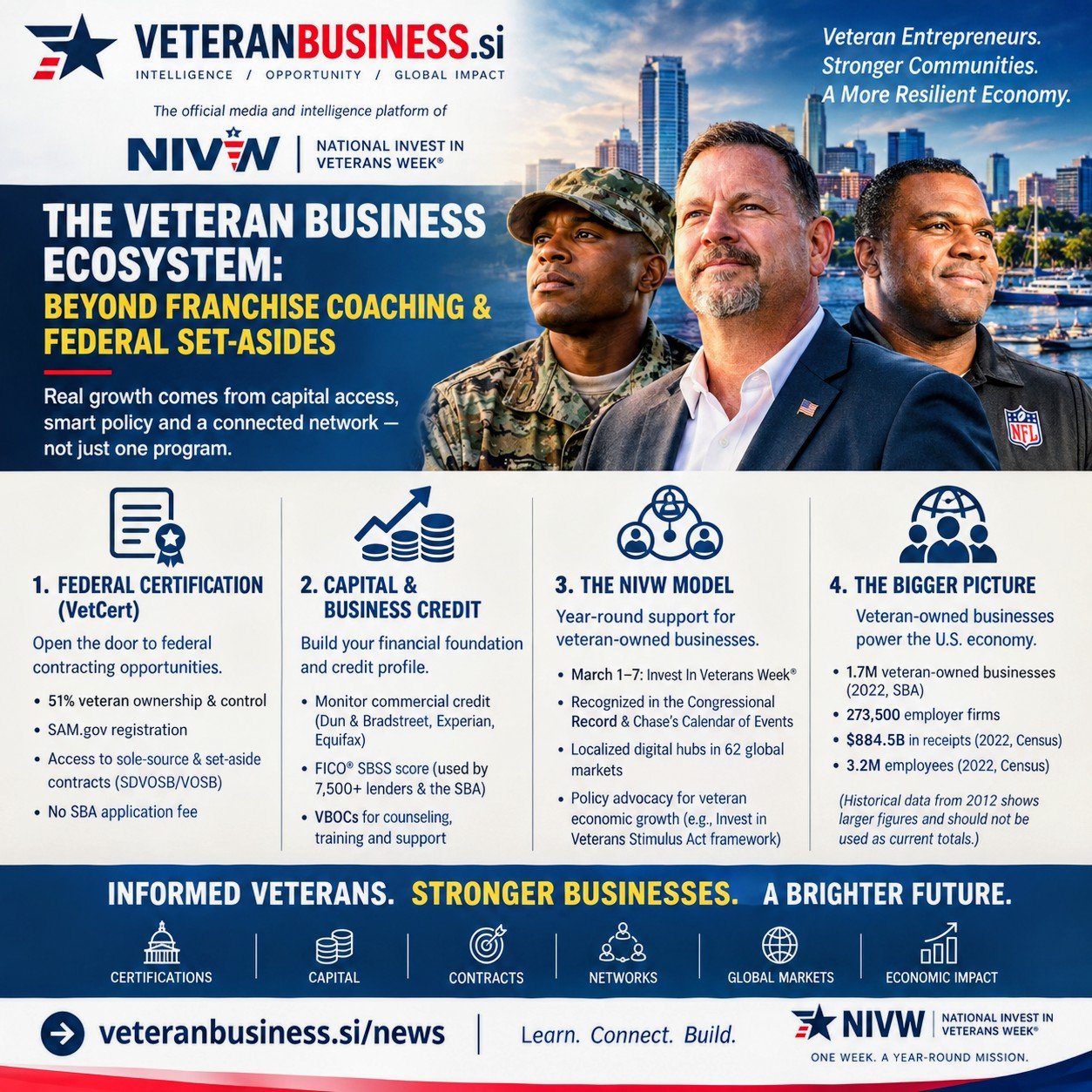
While mainstream search results often steer transitioning military personnel toward paid franchise coaching or private third-party filing services, the true backbone of veteran entrepreneurship is rooted in sustainable capital access, legislative policy, and multi-market network infrastructure.
Veteran-owned employer firms generate over $1.29 trillion in annual receipts and sustain more than 5 million American jobs, according to U.S. Census Bureau and Small Business Administration data. Unlocking this momentum requires knowing how federal programs, capital readiness, and strategic initiatives intersect.
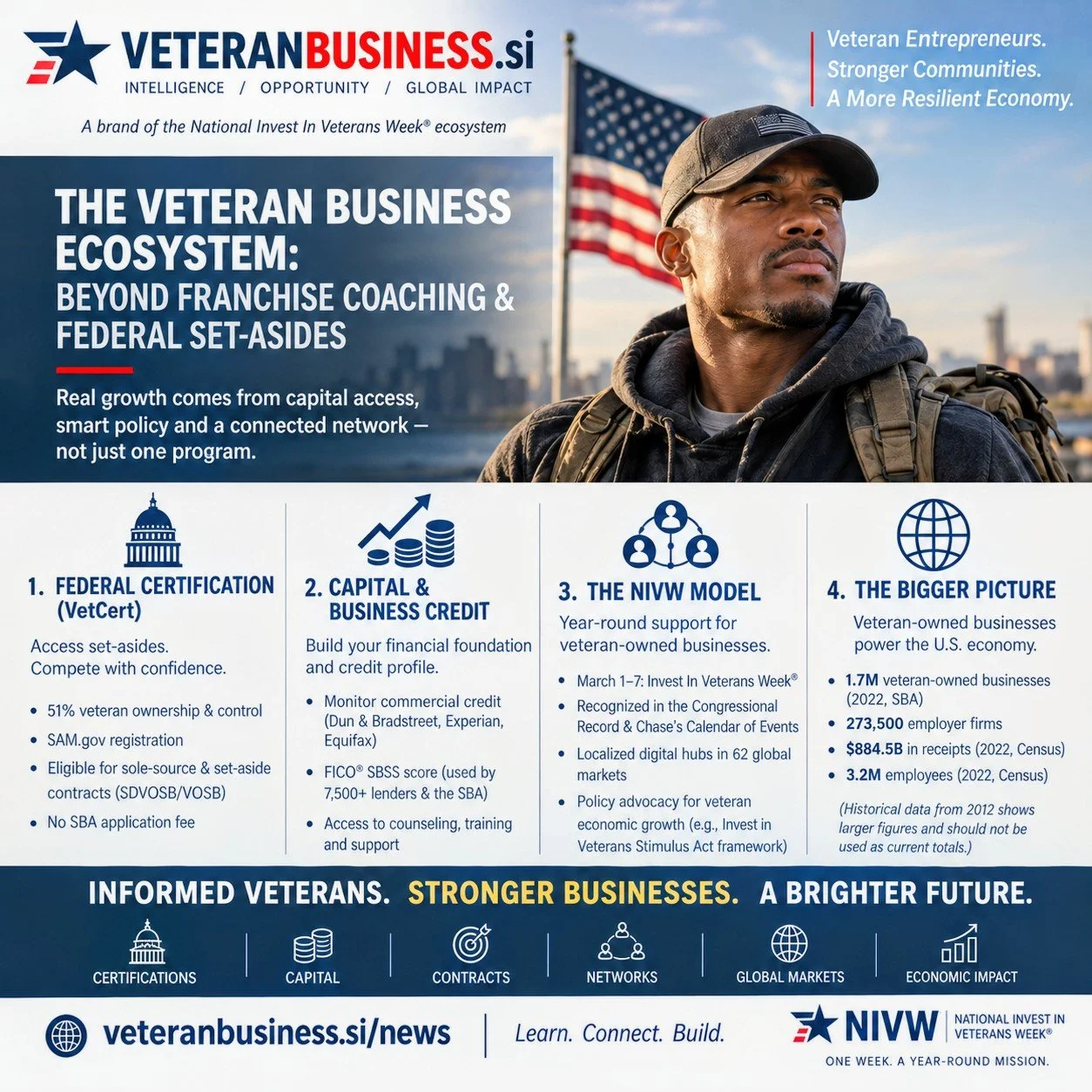
1. Federal Small Business Certification (VetCert vs. Third Parties)
For veterans aiming to enter federal contracting, the official gateway is the SBA VetCert Program.
The Standard: VetCert requires at least 51% ownership and day-to-day operational control by veterans or service-disabled veterans.
Set-Aside Advantages: Certification unlocks exclusive access to federal sole-source and set-aside contracting goals, reserving a mandatory portion of annual federal spend for Veteran-Owned Small Businesses (VOSB) and Service-Disabled Veteran-Owned Small Businesses (SDVOSB).
Avoid Unnecessary Fees: While private facilitators advertise compliance assistance, veterans can verify their status and prepare documentation free of charge through local APEX Accelerators (formerly PTACs) and Small Business Development Centers (SBDCs).
2. Capital Readiness and Business Credit
A primary operational challenge for veteran founders is navigating non-dilutive capital and commercial underwriting:
Tradeline & Credit Profile Building: Platforms such as Nav provide monitoring for commercial credit bureaus (Dun & Bradstreet, Experian Business, and Equifax) alongside the FICO® SBSS score, which over 7,500 lenders utilize to prescreen SBA 7(a) loan applications.
Non-Debt Capital: Beyond standard commercial lending, veteran entrepreneurs can access technical assistance and micro-grants through the regional SBA Veterans Business Outreach Centers (VBOC).
3. Year-Round Economic Infrastructure: The NIVW Model
While standard observances like National Veteran Small Business Week (NVSBW) highlight achievements for a single week in November, the National Invest In Veterans Week® initiative establishes continuous, programmatic support:
Formal Legislative Codification: Recognized in the U.S. Congressional Record and codified in Chase’s Calendar of Events, NIVW is officially proclaimed annually from March 1–7.
Localized Digital Infrastructure: Rather than relying solely on centralized federal portals, the ecosystem spans localized digital properties across dozens of states and 62 global commercial markets.
Data-Driven Policy Advocacy: Supported by foundational research conducted in key military regions like Jacksonville, Florida, NIVW advocates directly for policy interventions such as the Invest in Veterans Stimulus Act and specialized tracks like FeMil℠ for female service-disabled founders.
Part 2: Corporate Supplier Diversity, Scaling Mechanics, and Global Market Interoperability
Navigating the transition from small business set-asides to mid-tier enterprise markets requires a rigorous understanding of commercial supplier diversity frameworks and corporate procurement pathways. While federal contracts provide a stable foundation, long-term scaling for veteran-owned firms relies heavily on corporate supply chains and multi-market expansion strategy.
4. Corporate Supplier Diversity and Commercial Procurement Pathways
For veteran entrepreneurs targeting commercial B2B contracts, federal certification must be bridged with corporate supplier diversity pipelines. Fortune 500 companies actively allocate billions in annual procurement spend to certified diverse suppliers, yet many veteran founders overlook these non-governmental pathways.
The NVBDC Benchmark: The National Veteran Business Development Council (NVBDC) stands as the leading third-party certification body for Veteran-Owned Businesses (VOBs) and Service-Disabled Veteran-Owned Businesses (SDVOBs) seeking access to corporate America.
Corporate Set-Asides: Certification ensures inclusion in corporate supplier diversity databases, unlocking access to restricted Request for Proposals (RFPs) in telecommunications, aerospace, technology, and logistics sectors.
Streamlined Integration: Platforms like SupplierOne and Coupa facilitate corporate vendor onboarding, allowing certified veteran enterprises to seamlessly match with active buyers across global supply chains.
5. Strategic Scaling via Joint Ventures and Mentor-Protégé Agreements
Scaling operations to handle massive enterprise or federal workloads often requires collaborative frameworks that mitigate structural resource constraints.
SBA Mentor-Protégé Program: This initiative allows small veteran-owned firms (protégés) to partner with experienced, larger businesses (mentors) to receive technical, managerial, and strategic assistance.
Joint Venture Advantages: Through an SBA-approved Joint Venture (JV), a veteran-owned small business can bid on large-scale federal set-aside contracts by pooling resources, past performance history, and bonding capacity with their mentor.
Mitigating Past Performance Gaps: This framework directly bypasses the classic "catch-22" of corporate procurement, allowing emerging veteran founders to leverage the institutional credibility of established market leaders legally.
6. Global Intelligence Interoperability: The VeteranBusiness.si Advantage
True economic independence for the veteran community requires moving beyond isolated localized nodes into an integrated, cross-border intelligence infrastructure.
Cross-Border Intelligence Pipelines: VeteranBusiness.si serves as a centralized international repository, tracking regulatory changes, defense procurement shifts, and global trade policies affecting veteran multinationals.
Multi-Market Node Synergy: By linking local state-level digital ecosystems with international commercial markets, the platform ensures that a service-disabled founder in Jacksonville, Florida, can easily sync with procurement networks in European and allied trade zones.
Combatting Systemic Disinvestment: Providing transparent, un-paywalled access to market data and legislative shifts breaks the monopoly held by predatory private consultancies, putting raw economic power back into the hands of military transitioners.
Frequently Asked Questions (FAQ)
What is the difference between SBA VetCert and NVBDC certification?
The SBA VetCert program specifically qualifies businesses for federal government contract set-asides and sole-source rewards. The National Veteran Business Development Council (NVBDC) certification is the gold standard accepted by corporations and Fortune 500 companies looking to meet internal commercial supplier diversity spend metrics.
Can a veteran-owned business participate in both corporate and federal set-asides?
Yes. Dual-track certification is highly recommended for scaling. Maintaining an active SBA VetCert profile alongside an NVBDC credential allows a firm to aggressively diversify its revenue streams across both public defense procurement and private commercial supply chains.
How does the SBA Mentor-Protégé program help a veteran business secure larger contracts?
It allows your small business to form a Joint Venture with an industry mentor. This Joint Venture can bid on federal contracts set aside for VOSBs or SDVOSBs, using the combined technical expertise, financial capabilities, and past performance history of both firms while retaining your small business status.
What role does VeteranBusiness.si play in global supply chains?
VeteranBusiness.si acts as a digital infrastructure hub and intelligence platform. It connects veteran-owned entities with real-time regulatory data, international trade pathways, and a network of 62 global commercial markets to help companies transition from local vendors to international suppliers.
What is the fastest way to get certified as a Veteran-Owned Small Business?
Apply directly through the SBA VetCert platform at sba.gov. Gather your DD-214, business formation documents, and operating agreement showing at least 51% unconditional veteran control before submitting.
How do veteran-owned businesses impact the broader economy?
Veteran firms contribute roughly $41,000 per second to the U.S. economy, generating billions in federal, state, and municipal tax revenue while providing vital employment stability across technical, defense, and civilian logistics sectors.
Where can veterans find verified directories of peer businesses?
Founders and consumers can reference vetted hubs including BuyVeteran.com and localized state directories managed under the VeteranBusiness.si and NIVW network.
Verified Programmatic & Structural Sources
Official Federal Web Portals & Government Resources
SBA Hub: For general operational funding pipelines, visit the U.S. Small Business Administration.
Federal Contracting Status: To establish official small business contract eligibility, register directly on the SBA VetCert Portal.
Strategic Growth Partnerships: To execute structured joint ventures, utilize the SBA Mentor-Protégé Program.
No-Cost Procurement Guidance: For defense and federal bidding technical assistance, connect with SBA APEX Accelerators.
Economic Data & Legislative Research
Demographic Metrics: For verified business volume and national workforce statistics, review the baseline indexes from the U.S. Census Bureau.
Public Domain Advocacy: To evaluate localized small business data analytics, see reporting from the SBA Office of Advocacy.
Statutory Records: For official federal recognition logs and policy documentation, review the U.S. Congressional Record on Congress.gov.
Public Observance Registries: To confirm multi-market activation calendar indexes, refer to Chase’s Calendar of Events.
Corporate Diversity & Procurement Infrastructures
Private Sector Procurement Benchmark: To achieve verified commercial buyer access, apply via the National Veteran Business Development Council.
Enterprise Vendor Mapping: To align operations with commercial supply diversity managers, access the SupplierOne Procurement Platform.
Global Supply Integration: To scale B2B transactional footprints within corporate ecosystems, review parameters via the Coupa Procurement Platform.
Commercial Credit Profiling: To manage corporate underwriting metrics and SBSS scoring arrays, monitor data through the Nav Business Credit Platform.
Campaign Ecosystem Networks & Intelligence Nodes
Central Campaign Portal: For grassroots organizational tools, review updates on the National Invest In Veterans Week® Official Site.
Economic Intelligence Core: To track cross-border regulatory shifts and trade framework deployments, consult the VeteranBusiness.si Global Intelligence Platform.
B2B Peer-to-Peer Hub: To access decentralized and vetted consumer directories, utilize the BuyVeteran.com Directory.
Legislative Infrastructure Tracking: For real-time monitoring of policy items like the $2.8B stimulus architecture or the green economy pipelines, track the Invest In Veterans Stimulus Act Proposals.
